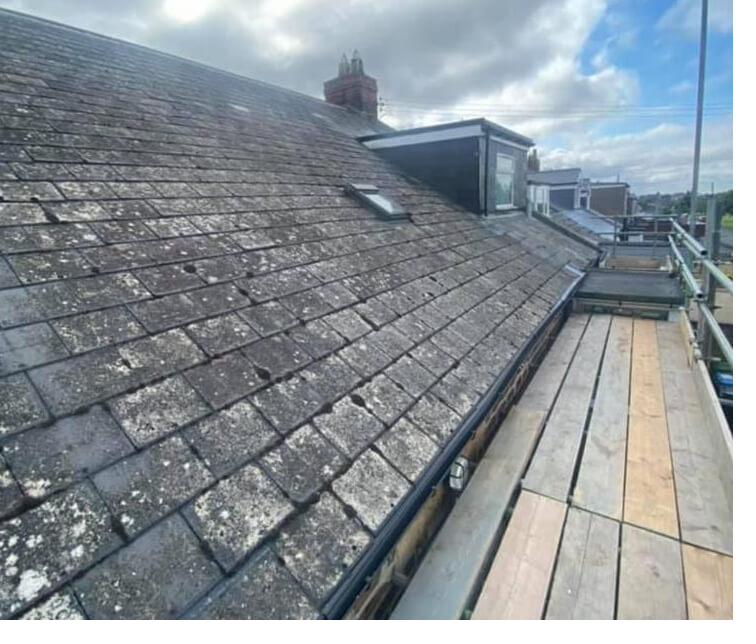
Why Sheffield Chimneys Need So Much Work
Most Sheffield chimneys were built between about 1880 and 1940, using locally-made soft red brick and lime mortar. That mortar has been weathering for a hundred-plus years — rain has leached it out of the joints, frost has broken pieces away, and by now it's often gone back to nearly sand in places. Once the mortar gives up, the bricks start shifting. Once bricks shift, the chimney leans. Once it leans past a certain point, it becomes unsafe.
On top of that, the flashings around the base of the chimney (where it meets the roof) are often the weakest link in the whole roof. If they were fitted in the 1970s or 80s with cement fillets rather than proper lead, they've almost certainly cracked and started letting water in. That water runs down the side of the stack, soaks into the mortar, and accelerates the whole failure cycle.
Repointing — The Most Common Repair
If the bricks themselves are sound but the mortar joints are crumbling, repointing is the fix. We rake out the failed mortar to a depth of about 20–25mm, brush out the dust, and re-fill with a lime-based mortar that matches the original. Crucially, we use lime and not Portland cement — cement is too hard, traps moisture in the bricks, and causes spalling (where the brick face pops off in winter). Lime mortar breathes, flexes with the brickwork, and lasts 60 to 100 years when done properly.
Repointing a typical two-pot chimney stack, including scaffolded access, takes two to three days. The scaffold is usually the bigger logistical issue than the repointing itself — we have to erect a proper tower, not just bounce the ladder up there. For an average Sheffield semi, budget £1,200 to £2,000 for a full repoint with scaffold.

Full Rebuilds — When Repointing Isn't Enough
If the bricks themselves are shot — spalled faces, missing corners, stack visibly leaning — repointing is a waste of money. The right answer is a full rebuild from the roofline up. We take the stack down carefully (salvaging any pots that are sound), set new lead tray flashings into the roof, and rebuild with new or reclaimed brick in lime mortar. Pots get re-bedded with ventilated caps if the flue is disused, or capped off entirely if it's been permanently sealed.
A full stack rebuild on a three-bed semi is a four to six day job with scaffold — typically £2,500 to £4,500 depending on size, number of pots, and access. We'll give you a fixed-price written quote after inspection. Once rebuilt, a chimney should be good for another 80 to 100 years with minimal maintenance.
Leadwork & Flashings
The second most common chimney problem after mortar failure is flashing failure. The flashings are the lead strips that seal the junction between the chimney and the roof — the front apron, the side step flashings, and the rear back gutter. Properly fitted lead (code 4 or code 5, to BS EN 12588) lasts 80 years plus. Cement fillets dressed with bitumen paint, which you see on a lot of older repairs, last 10 to 15 at most.
When we replace flashings, we chase new lead at least 25mm into the brickwork, wedge it with lead wedges, and point it up with lime-based mortar. The side step flashings are cut and lapped properly over the adjacent tiles or slates. Done right, you get a completely weatherproof junction that will outlast the chimney.

Pot Replacement & Capping
Old chimney pots crack, the rims crumble, and the sooty mortar bed they sit on breaks down. We hold a small stock of typical Sheffield clay pot styles — roll-top, cannon-head, beehive — so we can usually match what's there. If the flue is still in use, the pot needs to be the right internal diameter and height for the appliance connected to it.
If the flue has been disused for years, we can cap it off entirely, or fit a ventilated hood that keeps rain out but lets the flue breathe (which stops damp problems inside the breast). Either way, everything gets properly bedded with fibre-reinforced mortar so it can't wash out.